Why Cryptography Matters in Modern Systems
Cryptography is often linked with secrecy, but its roles go way beyond. What it does is to provide a great sense of honor in atmospheres where parties may not know or trust each other. In varied contexts, from messaging to financial systems, cryptographic methods pertain to who may access data, under which kind of conditions, and with what kind of assurances.
Cryptography minimizes dependence on central control in a particular system. Instead of depending on but one unbroken chain of keys to yield honesty, a system can shed its faith in mathematical and physical proofs and bulwarks. In this respect, data transit of various kinds, between different nations, in various platforms, may pass through different regulatory frameworks.
From Secrecy to Controlled Access
Early cryptography focused on hiding messages from unauthorized readers. Modern systems still rely on secrecy, but the emphasis has shifted toward controlled access. Data often needs to be queried, verified, or processed without being fully revealed to the party performing the operation.
This change reflects real-world needs. Medical records, financial data, and identity credentials cannot simply remain locked away. They must be usable under strict conditions. Cryptography provides mechanisms to define those conditions precisely, allowing limited interaction with data while preserving confidentiality.
Trust Without Assumptions
Traditional digital systems depend heavily on institutional trust. Users trust service providers to store data securely, enforce permissions correctly, and resist misuse. Cryptographic systems reduce this dependency by embedding trust into protocols rather than organizations.
By relying on mathematical properties instead of promises, cryptography allows participants to verify outcomes independently. This does not eliminate institutions, but it narrows their role. The result is a more resilient model where trust is distributed and easier to audit.
Responding to Scale and Complexity
As systems scale, manual oversight becomes impractical. Millions of transactions, queries, and data exchanges happen continuously. Cryptography allows these interactions to occur automatically while maintaining consistent security guarantees.
This is especially important in distributed systems, where data may be fragmented across locations and jurisdictions. Cryptographic controls travel with the data, ensuring that protection does not depend on where information is stored or processed.
Encryption as the Foundation
Encryption is the most familiar cryptographic tool. At its core, encryption transforms readable data into an unreadable form, accessible only to those with the correct key. While the concept is simple, its implications are far-reaching.
Encryption underlies everything from secure websites to encrypted storage. It ensures that even if data is intercepted or accessed improperly, it remains unintelligible without authorization.
Symmetric and Asymmetric Encryption
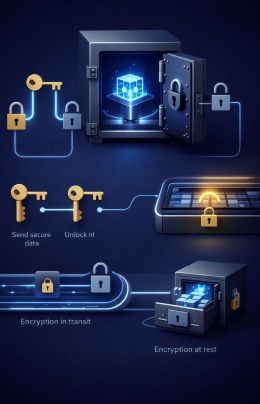
Symmetric encryption uses a single shared key for both encryption and decryption. It is efficient and well suited for large volumes of data. However, securely sharing the key can be challenging, especially across open networks.
Asymmetric encryption addresses this by using key pairs. A public key encrypts data, while a private key decrypts it. This model enables secure communication without prior key exchange and forms the basis of many secure protocols used today.
Encryption at Rest and in Transit
Data is vulnerable both when stored and when moving between systems. Encryption at rest protects data on disks, databases, and backups. Encryption in transit secures data as it travels across networks.
Both forms are necessary. Encrypting only during transmission leaves stored data exposed to breaches. Encrypting only at rest leaves data vulnerable during exchange. Together, they form a baseline for secure data handling.
Limits of Traditional Encryption
While encryption is powerful, it has limits. Once data is decrypted for use, it becomes exposed within the system handling it. This creates a gap between protection and usability.
Many security failures occur in this gap. Data may be encrypted on disk but processed in plaintext in memory. Cryptography alone cannot solve this problem, which is why newer approaches focus on minimizing when and where decryption occurs.
Zero-Knowledge Principles
Zero-knowledge proofs represent a fundamental transformation in the method of proving. They make it possible for a prover to demonstrate the validity of a statement without disclosing the actual data. At its core is a fundamental questioning of the idea that getting functionality also means getting privacy. Zero-knowledge proofs allow a system to confirm the truth, no matter how securely a user can keep his sensitive inputs hidden from the verifier.
What Zero-Knowledge Really Means
A zero-knowledge proof allows one party to convince another that a statement is true without revealing why it is true. The verifier gains confidence, but no additional information.
In practice, this means a system can verify eligibility, correctness, or compliance without accessing raw data. The proof itself carries the assurance, reducing the need for trust in the prover.
Use Cases Beyond Theory
Once considered purely academic, zero-knowledge methods are now used in practical systems. They support private authentication, confidential transactions, and selective disclosure of credentials.
For example, a user might prove they meet an age requirement without revealing their birthdate. This kind of interaction aligns closely with privacy regulations that emphasize data minimization.
Trade-Offs and Constraints
Zero-knowledge systems are not free of cost. They often require more computation and careful design. Implementing them incorrectly can undermine their guarantees.
Despite these challenges, their value lies in changing what is possible. They allow system designers to rethink data flows, reducing exposure by design rather than by policy.
Private Querying and Confidential Computation
The conventional security-behind algorithm practices are intended to be unacceptable for any cryptographic use as sharing data requires sending data between client and server for any possible harm to remain untouched. Further is the imposition of a unique and strict privacy chain valid for user friendships. In this context, it is good to propose implementing cryptographic query processing, which primarily revolves around two main lines: direct application of atomic queries and the modification of the elements about which one dynamically interacts.
Separating Questions From Answers
In traditional systems, querying a database reveals both the query and often more data than necessary. Private querying techniques decouple these elements.
A system can compute an answer without learning what was asked, or return an answer without revealing underlying records. This separation reduces the risk of inference and misuse.
Multi-Party Computation
Multi-party computation allows multiple parties to jointly compute a result without revealing their individual inputs. Each participant contributes data, but no one sees the full picture.
This approach is useful when collaboration is needed but trust is limited. It supports scenarios like joint analytics across organizations without sharing raw datasets.
Performance and Practicality
Private computation techniques are more complex than conventional querying. They require careful coordination and often involve performance trade-offs.
However, as computational resources improve and methods mature, these techniques are becoming more practical. Their adoption reflects a growing demand for privacy-preserving analytics.
Using Data Without Transferring It
Perhaps one of the most intriguing effects created by cryptography is the distance created between computations and data. As opposed to data being moved away and brought to computations, this leads to a situation where computations are moved to where the data already is. This inversion moves away from duplication, lays down some safety boundaries, and at the same time lines up well with the regulatory expectation on residency and control.
Data Localization by Design
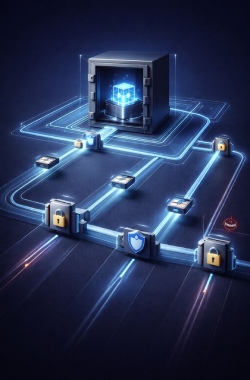
Many regulations restrict where data can be stored or processed. Cryptographic access controls support compliance by allowing remote use without physical transfer.
Systems can grant temporary, limited access to results rather than raw data. This approach respects jurisdictional boundaries while maintaining functionality.
Minimizing the Attack Surface
Every copy of data increases risk. By reducing duplication, cryptographic systems shrink the attack surface.
When data remains in one place and access is mediated cryptographically, fewer systems need to be trusted. This simplification improves both security and auditability.
Shifting Responsibility to Protocols
Traditional data sharing relies on contracts and policies to prevent misuse. Cryptographic systems encode restrictions directly into protocols.
This does not remove legal responsibility, but it reinforces it with technical safeguards. Misuse becomes harder not because it is forbidden, but because it is mathematically constrained.
Governance, Compliance, and User Protection
Cryptography plays a role of increasing importance with regard to complying with regulations. Many digital privacy orientations stress data minimalization, purpose limitation, and user control, all of which are directly supported by cryptographic principles. Therefore, the means, the design of the systems and products themselves may serve as enforcement for regulatory compliance.
Auditability and Verifiability
Cryptographic systems can produce verifiable logs and proofs of correct behavior. Auditors can confirm that rules were followed without inspecting sensitive data.
This capability supports oversight while preserving confidentiality. It also reduces the burden on organizations to expose internal systems during audits.
User-Centric Control
By tying access to cryptographic keys, users gain more direct control over their data. Permissions can be granted, revoked, or limited without involving intermediaries.
This model aligns with evolving expectations around digital rights. Users are not just data subjects, but active participants in access decisions.
Aligning Technology With Policy
Regulation often lags behind technology, but cryptography helps bridge the gap. By enforcing constraints technically, systems can comply with broad principles even as rules evolve.
This flexibility is important in global environments where legal requirements differ. Cryptography provides a consistent foundation that can adapt to local interpretations.
Challenges and Misconceptions
Despite its promise, cryptography is not a silver bullet. Misunderstandings about its capabilities can lead to misplaced confidence or poor design choices.
Recognizing limitations is as important as understanding strengths.
Complexity and Implementation Risk
Cryptographic systems are unforgiving of errors. Small mistakes can undermine security entirely.
This makes expertise and careful review essential. Secure systems depend not just on algorithms, but on correct integration and ongoing maintenance.
Performance Expectations
Certain cryptographic schemes are significantly computationally intensive. One cannot project them to match the prevailing systems without any trade-offs. Balancing privacy, security, and efficiency will face the designers. The trade-offs are appreciated when designing realistic and sustainable systems.
Key Concepts at a Glance
This section highlights core ideas that recur across cryptographic systems and secure data access models.
- Encryption protects data from unauthorized access, both at rest and in transit.
- Zero-knowledge methods enable verification without disclosure.
- Private querying allows questions to be answered without exposing data or intent.
- Data use without transfer reduces risk and supports regulatory compliance.
- Cryptographic controls complement, rather than replace, legal and ethical frameworks.
- These concepts work together to reshape how data is handled in complex systems.
Building Trust Without Exposure
Much more than obscuring, cryptography explicitly facilitates use, collaboration, and authentication within imposed parameters. Cryptographic systems back up a world in which the protection of information resides in being able to use it at the same time. This is a must-known concept for people entrenched in or busy touching any aspect of modern digital systems.
#InternationalDataPrivacyDay
— All India Radio News (@airnewsalerts) January 28, 2026
🔹International Data Privacy Day is being observed today to raise awareness about protecting personal data and privacy in the digital age.
🔹Also known as #DataProtectionDay, it was designated in 2006 by the Council of Europe to mark the signing of… pic.twitter.com/Bv1aB7i4NO